Friday, 17 October 2014

A New Way of Crimping

In Helen's lesson this week, we practised a new way of 
crimping. Many people think that crimping can only be done using crimpers (I was one of these people!) but thats not the case. Using a Geisha Pin and some hair straighteners, you can achieve an amazing, springy crimp. 


 1.Take a small section, and wrap the hair in a formation of eight around the Geisha pin, and use a kirby grip to secure. You can start at the root of the hair, or half way down, depending on how you want your look. 
2. Use straighteners to heat the hair, for about 5-6 seconds. 

 3. Remove the kirby grip and the geisha pin, to achieve this hair spring!
 4. You can choose to keep the hair in this wavy formation above, or you can brush the hair to achieve the look below! This can now be easily manipulated, and gives the hair much more volume. 

This style of crimp was used by the Elizabethans, it can clearly be seen in many of Queen Elizabeth's portraits, such as 'The Rainbow Portrait'. The Queen can be seen with the crimp loosely hanging down by her shoulders, and have not been brushed out to create volume, but left untouched to create the pattern.
'The Rainbow Portrait'
c.1600.
Viewed 17/10/2014
Available from: www.hatfield-house.co.uk/content.asp?id=1...The-Rainbow-Portrait
Crimping is still seen in todays culture, such as supermodel Tyra Banks. Many people think 90's with this look, but Tyra gives this style a new flare with her coppery locks, and messy ponytail.

Tyra Banks
Vibe Awards 2004.
Viewed 17/10/2014
Available from: http://tyrabanksfan.com/visuals/displayimage.php?pid=3483

Elizabethan Inspired Hairstyles Practical

In this week's practical with Helen, we were using the skills we had learnt in Lottie's lesson on buns and plaits to create our own Elizabethan inspired hairstyles. I was inspired by the Elizabethan fashion, especially the bodices like this one:
Mary Queen Of Scots
by Unknown artist
oil on panel, transferred to canvas, circa 1570
NPG 96
National Portrait Gallery
viewed 17/10/2014
available from:
http://www.npg.org.uk/collections/search/person/mp02996/mary-queen-of-scots
I wanted to somehow include the way they laced the corsets, so I decided I would lace the hair with ribbon. 

 By creating a centre parting and French plaiting, this gave the impression of padding when the hair was slack. I tried this look with and without twisting the fringe, to experiment with what made it look more Elizabethan. Personally I prefer the rolls at the front of the hair. 

 I twisted a front section of the hair to give the impression of 'Rats', and entwined it into the plait.

 After i had completed both french plaits on either side of the hair, I then sewed ribbon into the hair, in the 'X' formation the Elizabethans used when tying their corsets. I really enjoyed experimenting with this look, and using different materials in the hair.

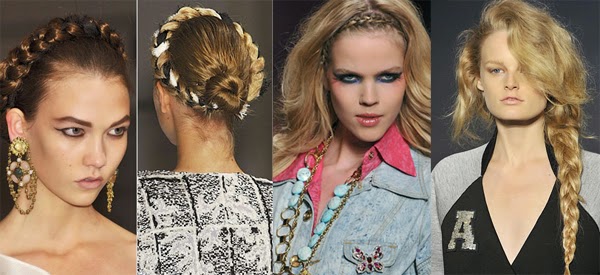
Catwalk braids decorated with Ribbon.
http://iliveforit.blogspot.co.uk/2011/05/jewls-13-new-creative-hairstyles-for.html
Braiding Ribbon through hair, particularly Plaits has been seen on the runway of catwalk shows for years. It adds more decoration to the hair than just a simple braid or plait. The ribbon can either add a more contemporary feel to the hair, or can add a more historic feel, (see images 1+2 above). Not only can ribbon be used in the catwalk, but everyday. It can add a touch of colour to the hair, or a bit of fun.


Modern Elizabethan Hairstyles..

Many hairstyles have been recycled throughout time over and over again. 
The iconic Amy Winehouse beehive for example, was previously seen in the 60's girl band 'The Ronettes'. 
The Ronettes
(DJ Soulspin, June 28th 2014. 'The Suite Delight: The Ronettes' (online). Viewed 17/10/2014.
available from:http://www.thesuitedelight.com/2013/06/the-ronettes.html)
Amy Winehouse
(Jack Catastrophe, November 20th 2014. 'The Sceptic:Amy Winehouse' (online). [Viewed 20/11/2014]. Available from: http://www.thesceptic.co.uk/4/)
There is not much difference in the hair styles, apart from a contemporary twist on Amy Winehouse's. This is what many designers and stylists have done throughout the years, using the techniques or style  of a historical look, and putting a modern twist on it. They choose inspiration from any point in history, from the 2000's to the 1500's. 

This hairstyle at a Chanel catwalk reminds me of the Elizabethan hair, as the heart shape was primarily used in their hairstyles. The stylist for this look has padded out the hair just alike the Elizabethans would have done with the 'Rats' and adorned the hair with an accessory. What makes this look contemporary is the fringe, and the dash of grey within the up-do, as well as swapping jewels for flowers in the hair piece.
Chanel Pre-fall 2013 catwalk
Paris-Edinburgh
Viewed 17/10/2014
http://www.elleuk.com/fashion/celebrity-style/chanel-metiers-d-art-show-scotland

This hairstyle shown by a Chanel catwalk model is very close to an Elizabethan hairstyle. Queen Elizabeth achieved a very high style in her wigs and hair, just alike the stylist in this piece. The colour is not so dissimilar to that of Elizabeth's own, the infamous copper-red. The stylist has curled the model's hair very tightly, then brushed it out to create this crazy frizz, that is easily manipulatable for a high hairstyle.

Google search - Elizabethan Hairstyle.
The exaggerated size of the pearls in this piece makes this hairstyle contemporary, but definitely contains a hint of Elizabethan style. 

Beyonce Knowles in advert campaign for the O2.
2013
(O2, 4th February 2013. 'O2 announces exclusive priority partnership priority for Beyonce's UK leg of On The Run Tour' (online). [Viewed 17/10/2014]. Available from: http://news.o2.co.uk/2013/02/04/o2-announces-exclusive-priority-partnership-for-beyonces-uk-leg-of-the-mrs-carter-show-world-tour/)
The stylist for Beyonce's hair has been inspired by the Elizabethans in this image from the O2 commercial for her tour. The stylist has tightly curled Beyonce's hair, then brushed it out to achieve this maid frizz! The highlights within the hair make the individual curls stand out, just alike in some of the portraits of Elizabeth herself. 


Elizabethan Society

Elizabethan Society was dictated by the Great Chain Of Being. This was a social hierarchy of power. The hierarchy was as follows:

God 
Cherubs
Archangels, Angels
Star controllers of Destiny
Moon
King
Church
Princes
Nobles
Man
Lion
Other Animals
Oak and Rose
Other Plants
Gold
Other Minerals


Within the social hierarchy, there were four main classes. The Nobility, The Gentry, The Yeomanry and the Poor. A Person's class dictated how they were to dress, where they lived and the jobs they had. Noblemen were rich and powerful, therefore Henry VII and other Kings and Queens rarely appointed a new nobleman. They were a threat, to there power, so liked to have minimal numbers of this class. The Gentry were people like squires, knights, and gentlemen and women who were rich enough they did not have to work with their hands. This class grew rapidly in numbers, and became most important during this time as through generations they could build wealth and titles for themselves. The Yeomanry consisted of middle-class people, who lived comfortably with the money they had, but at any time they had an illness, or famine, could lose everything. The Poor found themselves without food or shelter. Their numbers were increasing, so the Poor Law was put in place. If any poor man or women who was capable to do an honest days work but chose to, would be sentenced to death. This controlled their numbers. 

(http://en.wikipedia.org/wiki/Great_chain_of_being)

(Isobel Bedingfield, October 2004. 'Extreme Costuming' (online).  [viewed 17/10/2014] available from: http://www.extremecostuming.com/articles/twoelizabethanhairstyles.html)


As mentioned, this hierarchy controlled every aspect of their lives. Women and men had to dress to their class, including their hair and makeup:

-The Coif, or 'Biggin' was worn by all Elizabethan children, and the poorer women and nuns. The white linen was a cheaper alternative for a head garment. The noble women would often wear coifs under their more elaborate head-pieces and hats, to simply keep the hair in place.

-The French Hood would be worn by the Noblewomen, as they were often adorned with jewels and pearls. 

-Hair worn long and down was fashioned by children and young women of all classes. This was a sign of virginity and an unmarried status.

-Hair worn up was generally worn by the older women. After marriage, hair would be swept up. This was a signal to men that they were married, another status symbol.

Elizabethan Hairstyles

Towards the end of the 16th Century in England, hairstyles had become far more elaborate, as women followed their fashion-consious Queen. Many women padded out their hair to achieve the high styles that were worn by the queen. As women were dying their hair to achieve the flame-red that Elizabeth herself had, their hair became thinner and thinner, due to the harshness of these dyes. This led to the high sales of wigs, for women who were not satisfied with their own hair.

In an Elizabethan Hair Pamphlet by well-travelled Londoner Phillip Stubbes named "The Anatomie of Abuses", he strongly criticised many of the fashions of the Elizabethan era.

"Then followeth the trimming and tricking of their heds in laying out their hair to the show, which of force must be curled, frizled and crisped, laid out on wreathes & borders from one eare to an other. And lest it should fall down, it is underpropped with forks, wyres, & I can not tel what, rather like grim stern monsters, than chaste christian matrones. Then on the edges of their bolstered heir (for it standeth crested round about their frontiers, & hanging over their faces like pendices or vails with glasse windows on every side) there is layd great wreathes of gold and silver, curiously wrought & cunningly applied to the temples of their heads. And for feare of lacking any thing to set foorth their pride withal, at their heyre, thus wreathed and crested, are hanged bugles, ouches, rings, gold, silver, glasses , & such other gewgawes and trinckets besides, which, for that they be innumerable, and I unskilfull in wemens terms, I cannot easily recount."


(Drea Leed,  1996-2008. ‘Elizabethan Costume’ (online). [viewed 17/10/2014] available from: http://www.elizabethancostume.net/stubbes.html)

(Linda Alchin, 2014. 'Elizabethan Makeup (online)' [viewed 17/10/2014] Available from: http://www.elizabethan-era.org.uk/elizabethan-make-up.htm)
Rats 
To achieve the high styles that Elizabeth had, women used 'Rats' to pad out their own hair. These were pads made out of real hair, and at one end shaped at a point like a nose, with the opposing end rounded, just a like the haunches of a rat. The hair would be sectioned into two, from ear to ear across the top of the head. The back section would then be sewn into a bun (Elizabethans did not have bobby pins like nowadays) and the front section then parted in the centre. The 'rat' would be rolled into the hair starting at the ends, then secured at the scalp to achieve the look of large, tight curls.


Long hair
Hair was worn long and down by the younger women of the Elizabethan era. Long hair worn down was a sign of a virgin, and favoured by the young women, and especially for a woman on her wedding day. Once married, the hair would be worn up. 

Elizabeth Vernon, Countess of Southampton. Unknown English artist (circa 1598)


Coif 
The Coif (often referred to as the 'big gin') was worn by many women and children. It was a plain white linen, covering the ears and head, tied under the chin. It was worn for warmth, protection from the elements, and to keep the hair out of the face, and worn by women of all classes. 
A clear depiction of a Coif appears in the portrait sketches by Hans Holbein in the 1530s. This one shows Anne Boleyn wearing a coif, fastened under the chin. 

French Hood
A French Hood was worn towards the back of the head. It was made on a stiff foundation, each side covering the ears. Anne Boleyn is primarily credited with bringing this style into England, during her stay in France she adopted this continental fashion, and upon her return, still fashioned it. French Hoods were one of the lasting fashions in this era. 

Elizabeth Seymour wearing a French Hood - Hans Holbein The Younger, c.1540


(Isobel Bedingfield, October 2004. 'Extreme Costuming' (online).  [viewed 17/10/2014] available from: http://www.extremecostuming.com/articles/twoelizabethanhairstyles.html)


Redheads and Royalty - Project Brief


Our project brief named 'Redheads and Royalty', is a mixture of contemporary and historical hair styling, based on the Elizabethan period. Queen Elizabeth was a great ruler of England, her reign often referred to as 'The Golden Age'. This time period saw the flourishing of poetry, music and literature, as well as the expansion and exploration abroad. Queen Elizabeth I was highly looked up to, she was a woman of great power. Her unmarried status led her to be depicted as a virgin or a goddess, making a virtue of her virginity. Elizabeth's look became a fashion, not just the pale-faced makeup but the copper hair too. 

Unknown Artist
viewed 17/10/2014
available from: http://goodmusicbrighterchildren.com/?p=2409

Queen Elizabeth had naturally fair hair, a trait that was instantly beautiful in this period. Many women dyed their hair, using cumin seed, saffron, celandine and oil, or even urine - human or animal! The ingredients for this were often expensive, so very fair hair would indicate high status. Eyebrows were often dyed lighter too, and had to be in an arch shape, so many women plucked theirs or even removed them completely and drew them back on in the shape they wanted to achieve. Eyebrows were not the only thing being plucked away in this period. It was important in the Elizabethan period to have a high hairline - this represented nobility - and many women would pluck theirs back to achieve this fashionable position. Although Elizabeth had this fair hair, she had up to 80 wigs at the time of her death. Due to the bleaching of the hair and the poisonous lead in the makeup she was applying daily, it began to fall out, leading her to use wigs and hair pieces. 

(Isobel Bedingfield, October 2004. 'Extreme Costuming' (online).  [viewed 17/10/2014] available from: http://www.extremecostuming.com/articles/twoelizabethanhairstyles.html)